
From the Kitchen to the Parlor: Language and Becoming in African American Women’s Hair Care
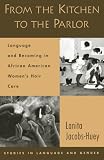
Product DescriptionWhen is hair “just hair” and when is it not “just hair”? Documenting the politics of African American women’s hair, this multi-sited linguistic ethnography explores everyday interaction in beauty parlors, Internet discussions, comedy clubs, and other contexts to illuminate how and why hair matters in African American women’s day-to-day experiences. . . . More >>
From the Kitchen to the Parlor: Language and Becoming in African American Women’s Hair Care


I’ll preface my review by saying that I am definitely not the intended audience for this book. I was forced to buy it when I took a class by the author, Lanita Jacobs-Huey, who is a professor at USC. Her class was called “Understanding Culture Through Film,” which sounded interesting. As it turns out, she devoted almost the entire class to ranting about black women’s hair.
If you are the sort of person who thinks that studying the social implications of black women’s hair is a worthy pursuit, then you should probably buy this book. For the rest of us, it’s full of academic psychobabble and deliberately overcomplicated terms for simple, unoriginal ideas. She could easily make all her points in 10 pages, and even then, they wouldn’t be very interesting. The main argument is that for black women, hair is more than “just hair,” it’s a vehicle for expression that is often highly charged with political implications (I’m sorry, but it’s hard to even summarize this book without sounding like academic psychobabble). But wait – at other times, hair is “just hair”! She never really develops the point much further than that or provides any sort of explanation for why things are the way they are, but peppers the text with meaningless words like “problematize” and “intertextual” to stretch out the length and make herself sound smart. If you find this sort of self-important drivel as obnoxious as I do, then don’t buy the book. And if you’re buying this book because you’re enrolled in any of her classes, drop the class immediately.
Rating: 1 / 5
This is an academic book, so the information presented is often dry and densely packed. However, I found that by reading it carefully, I felt I gained insights into the hair care world that I had only just suspected before. I guess it gave my hair-dresser paranoia a bit more fuel, but I found it enlightening at the same time. Though hair is just something that grows out of our head (if we are lucky, that is), it can often times be highly politically charged, especially for those of us of African descent. Jacobs-Huey delves mostly into the world of black hair dressers to study this interaction. She explores their world, and how they use language to take the care of black hair out of the hands of black women. They frequently do this through making their profession almost like a religion, complete with jargon that’s used to exclude the “uninitiated”. Though there has been much literature about hair, as well as the politics of black hair, Jacobs-Huey actually explores the conversations between white women, hair dressers of both races, and black women about hair care. She notes the meaning behind what at first glance appears to be simple conversations between women about hair, but upon analyzing them, she points out the politically loaded subtext within them. It becomes a sort of game loaded with meanings that often times one side is totally oblivious to. It also shows the dance between politeness, getting needs met, politics, racism, and self-expression women of different races and positions engage in around the topic of hair. Jacobs-Huey acts as documenter to the give and take conversations, revealing how women talk to each other about hair, rather than writing a one-sided political discourse on a particular philosophy of hair. I dropped out of letting professionals care for my hair a long time ago. So I found it fascinating to “infiltrate” (through Jacob-Huey’s book) the world of black hair care professionals who believe that the care of a woman’s hair should not be left to the novice. They use language to erect a barrier (rather than for true communication) so that the lay-person is excluded from understanding discussions about her own hair. This book illuminates the power struggle that goes on for who truly has control over a black woman’s hair.
Rating: 4 / 5